
St. Annenkirche Annaberg
Saxony's largest late Gothic hall church, with a 78 m tower – landmark of the mining town of Annaberg-Buchholz and a UNESCO World Heritage …
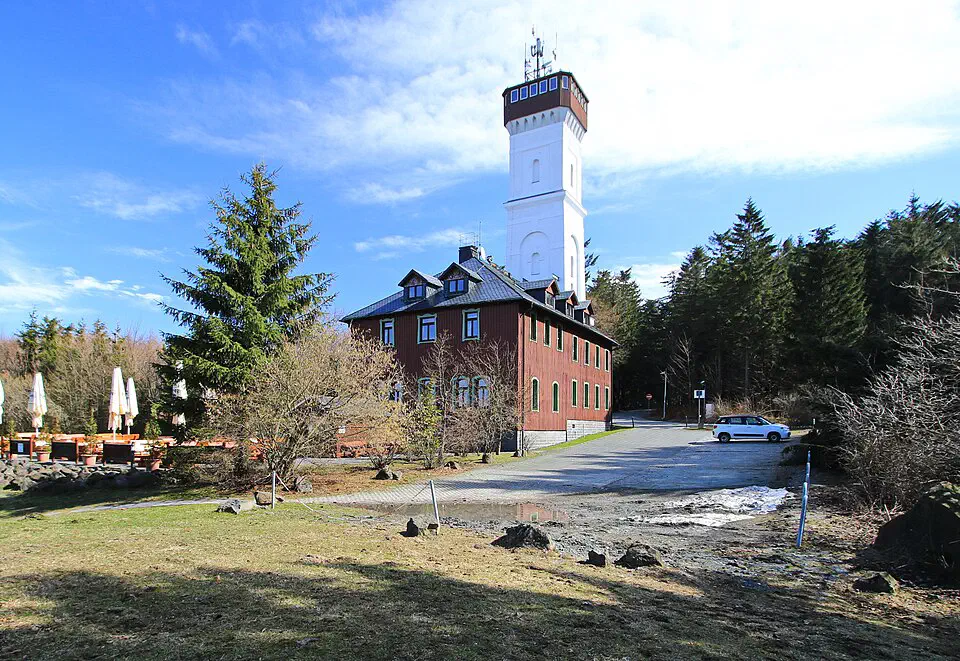
Basalt table mountain above Annaberg-Buchholz with an observation tower, a mountain inn and the "Butterfässer" (butter churns) basalt columns.
The Pöhlberg (831.1 m) is the remnant of a lava flow and consists mainly of basalt. The "Butterfässer" (butter churns) on the north side are basalt columns exposed by a former quarry. The roughly 35 m lookout tower was built in 1896 for Annaberg's 400th anniversary, and the mountain inn followed on 12 July 1897.
The loop starts at the Mischplatz car park, with the Kätplatz as an alternative. By bus, get off at "Annaberg-Buchholz, B 95/Am Kätplatz"; from Annaberg-Buchholz unterer Bahnhof the bus is recommended because of the climb.
The "Aussichtsglück und Märchenwald" loop is 3.3 km (about 1 h 10 min, easy) and passes basalt columns, the old bobsleigh run and a detour to the St. Briccius mine. Similar basalt hills nearby are the Scheibenberg and Bärenstein.
Hike to the stamp station Pöhlberg, open the free Steigerpass app and tap “Stamp in now” within 100 m. GPS confirms you're really there – even without signal, the app syncs later. You earn 20 points towards your next badge.
Nearby
Saxony's largest late Gothic hall church, with a 78 m tower – landmark of the mining town of Annaberg-Buchholz and a UNESCO World Heritage …
At the lower station in Annaberg-Buchholz, the large sculpture by the Dutch group Redfort architectural fabrics at first looks like a …
Historic hammer mill from the 15th century near Annaberg-Buchholz, one of the best-known technical monuments of the Ore Mountains and a …
Mountain above Frohnau with remains of the historic silver mining that prompted the founding of Annaberg. Views of Annaberg-Buchholz and the …
Accessible silver mine and UNESCO World Heritage site in Frohnau: the mine railway takes you 600 m underground to the reconstructed 9-meter …
Schlettau Castle probably dates back to a 13th-century motte castle on the old salt road. Around 1500 the abbots of Grünhain Abbey turned …