
Lauenstein Castle
Lauenstein Castle in the Altenberg district of Lauenstein grew out of a fortress whose oldest parts date from the mid-13th century. It …
Stamp station no. 142 · Mining World Heritage
Sächsische Schweiz-Osterzgebirge · 295 m above sea level
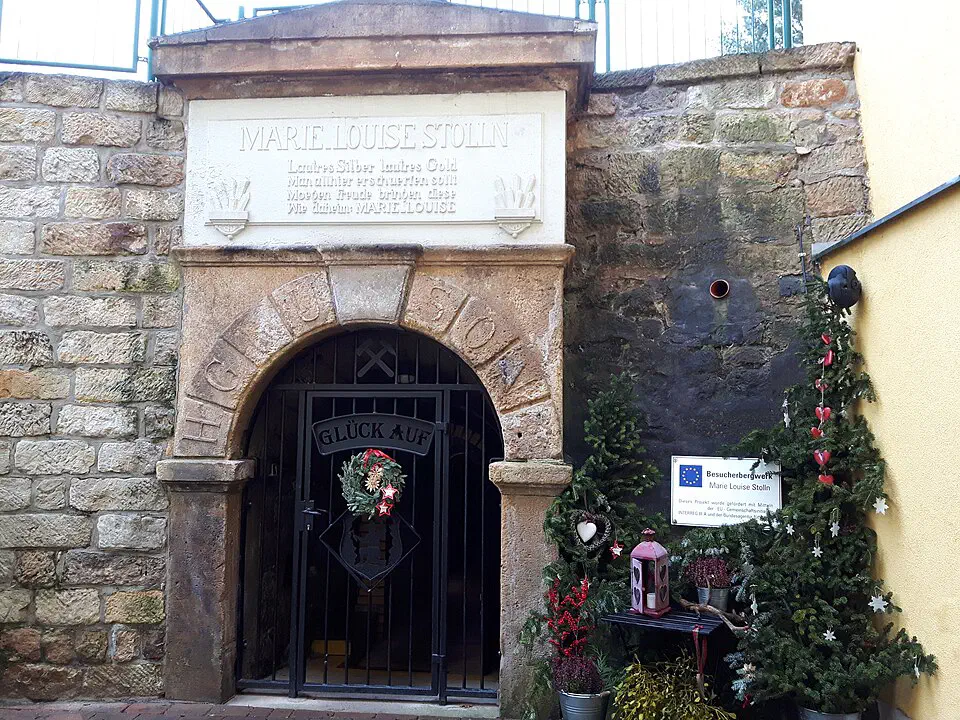
The Marie Louise Stolln in Berggießhübel began in 1726 as a drainage adit, the 'Friedrich Erbstolln'. From 1870 the industrialist Hermann Gruson had it enlarged and named after his eldest daughter; iron ore was mined in the district until 1892. It has been a show mine since 2006: the guided tour leads about 400 m into the hill to the former Mutter-Gottes ore deposit, through narrow sections only 65 cm wide and to an underground lake. The old ore-sorting house holds a mining exhibition, with mining equipment outside.
Hike to the stamp station Marie Louise Stolln Show Mine Berggießhübel, open the free Steigerpass app and tap “Stamp in now” within 75 m. GPS confirms you're really there – even without signal, the app syncs later. You earn 10 points towards your next badge.
Nearby
Lauenstein Castle in the Altenberg district of Lauenstein grew out of a fortress whose oldest parts date from the mid-13th century. It …
820.6 m basalt dome and landmark of the Altenberg region, with the 18 m Louisenturm (1891) and an all-round view far across the Elbe valley. …
The Altenberg Mining Museum is housed in the former tin-ore washery No. IV, which has its roots in the 16th century and was first documented …
Enormous collapse crater from historic tin mining on the edge of Altenberg, around 440 m across and up to 150 m deep, a UNESCO World …
The 786-metre Kohlhaukuppe, made of granite porphyry, rises south of Geising, not far from the Czech border. In 1889, for the 800th …
The Traugotthöhe lies southwest of Fürstenau, a district of Altenberg, in the Eastern Ore Mountains. It is a long, gently rounded hill about …