
“Glance” (Tanja Rochelmeyer)
In the roughly 100-metre pedestrian tunnel at Flöha station, Tanja Rochelmeyer has assembled 171 panels into an installation: frames, …
Stamp station no. 67 · Urban culture
Mittelsachsen · 276 m above sea level
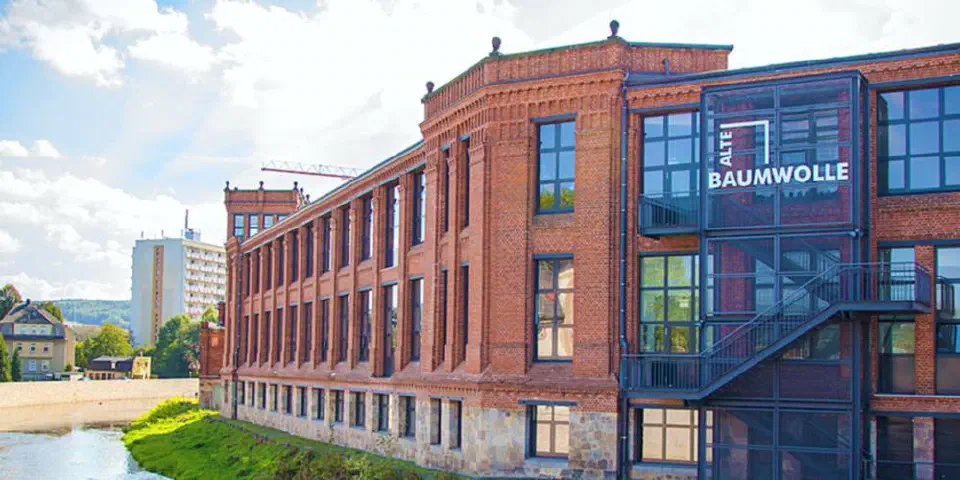
The former cotton mill of 1809 with its castle-like corner towers – one of Saxony's largest industrial monuments and today Flöha's town center with market square and town hall.
The complex on the left bank of the Zschopau began in 1809 with the first factory building, with extensions following, for example in 1867. Around 1900 it was regarded as the largest spinning mill in Saxony. Yarn production continued until 1990. Today the listed ensemble is Flöha's new town centre; the city administration moved into a renovated office building on the site in 2024.
Flöha station (RE 3 and RB 30) is within walking distance; there is park-and-ride parking at the station and a footbridge and underpass to Augustusburger Straße. A marked hiking trail runs from there through the Alte Baumwolle.
A worthwhile nearby destination is the Hetzdorf Viaduct, now a footpath and cycle route.
Hike to the stamp station Alte Baumwolle Flöha, open the free Steigerpass app and tap “Stamp in now” within 120 m. GPS confirms you're really there – even without signal, the app syncs later. You earn 10 points towards your next badge.
Nearby
In the roughly 100-metre pedestrian tunnel at Flöha station, Tanja Rochelmeyer has assembled 171 panels into an installation: frames, …
“Himmelwärts” (Heavenwards) is a work of sound: Pascal Kaufmann, cantor at Augustusburg’s St. Peter’s Church, composed the piece specially …
Two works meet at the Braunsdorf weaving museum: Anja Schwörer’s mural “Mapping Patterns: Industrial Flora” on the rear façade is made of …
A restful little spot with man-made water features.
Renaissance hunting lodge (1568–1572) on the Schellenberg high above the Zschopau valley – the "crown of the Ore Mountains", with a …
A 180-centimetre patinated bronze figure with a hare’s head: in “Usagi Greeting”, Leiko Ikemura combines the hare (Japanese: usagi) with …